

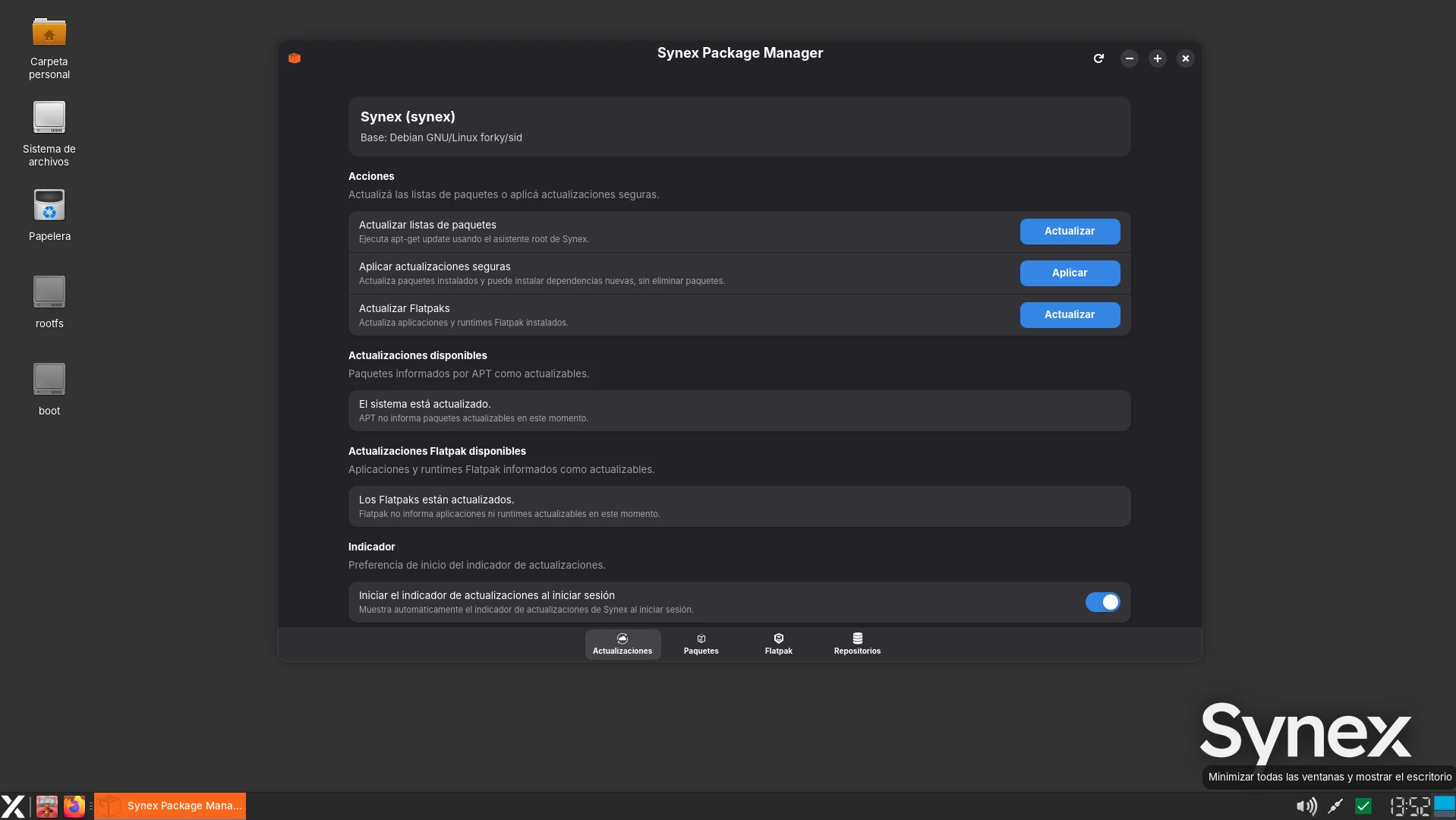
We are pleased to announce a new update to the Synex semi-rolling line, available in KDE Plasma, GNOME, and XFCE editions. This branch follows the Debian testing repositories and is aimed at users who want newer versions of the kernel, desktop environments, and system stack, while keeping the simple and consistent experience that defines Synex.
This release also marks an important step in consolidating the Synex Desktop ecosystem: Synex Package Manager now takes the central role in software management.
Synex Package Manager: a native tool for every desktop
The main change in this update is the inclusion of Synex Package Manager as the graphical software manager in the semi-rolling editions.
Until now, the different editions could rely on external tools depending on the desktop environment: Discover on KDE Plasma, GNOME Software on GNOME, or MX Package Installer as a general alternative. While these applications fulfill their purpose, they also create a fragmented experience: each desktop presents a different way to search for software, apply updates, or work with repositories.
Synex Package Manager solves this with a native tool shared across all desktop editions.
The application integrates into a single interface:
- APT package list updates;
- detection and application of safe updates;
- search, installation, and removal of Debian packages;
- prior simulation of APT operations;
- basic and safe repository management;
- repair of the official Synex repository;
- guided setup of known repositories;
- Flatpak support;
- search, installation, removal, and update of Flatpak applications;
- management of Flatpak runtimes and extensions;
- update indicator in the system tray.
The goal is not to replace advanced tools like Synaptic for deep technical administration, but to provide a clear, daily-use, controlled tool for Synex users. The interface is built with GTK/libadwaita, uses its own iconography, includes Spanish translation, and visually integrates with the rest of the system tools.
Less duplication, lower resource usage, and a more consistent experience
With Synex Package Manager as the software management hub, the new semi-rolling images remove the external graphical software managers that previously covered part of these functions, such as Discover, GNOME Software, and MX Package Installer.
This decision is not just about replacing one application with another. The goal is to reduce component duplication, avoid parallel management layers, and provide a uniform experience across KDE Plasma, GNOME, and XFCE.
In practice, this allows cleaner images and desktops with fewer processes and services associated with external software managers. It also simplifies Synex maintenance as a distribution: a single native tool can evolve together with the system, respecting its security criteria, visual design, and way of working with APT, Flatpak, and repositories.
Synex Package Manager uses a controlled root-helper for privileged operations, integrates polkit/pkexec when required, and does not execute arbitrary commands as root. Sensitive APT operations are simulated before being applied, repository modifications create backups, and safe updates avoid automatic removals.
Update indicator
Synex Package Manager also includes Synex Update Indicator, a tray application that starts with the session and keeps the user informed about available updates.
The indicator detects APT and Flatpak updates in the background, shows status through custom icons, and allows users to open Synex Package Manager or start the update flow from the tray menu. This replaces the need to depend on indicators or external services specific to each desktop environment, keeping the same behavior across KDE Plasma, GNOME, and XFCE.
Integrated Flatpak support
Flatpak is integrated into Synex Package Manager as an optional feature available from the same interface.
The application can detect Flatpak support, configure Flathub and Flathub Verified, refresh metadata, search applications, runtimes, and extensions, install or remove Flatpaks, and apply updates for both system and user scopes.
Flatpak updates are shown separately from APT updates inside the Updates tab, avoiding conceptual overlap while maintaining a unified workflow for the user.
Updated editions
This semi-rolling update maintains the three editions planned for the branch: KDE Plasma, GNOME, and XFCE.
The KDE Plasma edition includes Plasma 6.6.4, Plasma Workspace 6.6.4, and KWin 6.6.4, together with KDE Applications 26.04.0 such as Dolphin, Konsole, Ark, Kate, and Gwenview. The session uses SDDM 0.21 as the display manager.
The GNOME edition includes GNOME Shell 49.5, Mutter 49.4, GDM3 49.2, and GNOME Session 49.2. GNOME Flashback 3.58 is also included as an alternative for users who need an X11 session, which can be especially useful in certain compatibility, virtualization, or workflow-specific scenarios. Nautilus and GNOME Control Center are included in the 50.1 series.
The XFCE edition remains on the XFCE 4.20 series, with main components such as xfwm4 4.20, xfce4-panel 4.20.7, xfce4-session 4.20.4, and Thunar 4.20.8. This edition particularly benefits from Synex Package Manager, as it provides complete graphical management of packages, updates, and Flatpak without depending on heavier external tools.
Common components
The new images share an updated base on Debian testing / Forky. Main components include Linux kernel 7.0.4, systemd 260.1, OpenSSL 3.6.2, PipeWire 1.6.4, WirePlumber 0.5.14, Firefox ESR 140.10.1, and Flatpak 1.16.6.
The graphics stack includes Mesa 26.0.x, with minor variations depending on the edition at the time each image was built.
The installer remains based on Calamares 3.4.2 with calamares-settings-synex 1.0.23. The images also include native Synex ecosystem tools such as synex-center, synex-cleaner, synex-firmware-helper, synex-lvm-setup, synex-chroot, and synex-package-manager 0.4.5.
ZFS in the semi-rolling branch
ZFS support has been removed from these semi-rolling images.
The semi-rolling branch follows Debian testing, which provides access to newer software but also involves frequent changes in the kernel, toolchain, and external modules. For this update, we prioritized a more reproducible and consistent image composition, especially in the installation and system maintenance flow.
This decision applies only to the current semi-rolling images and will be reevaluated in future builds. Users who need installation or support on ZFS should use the stable Synex branch.
Considerations
The semi-rolling branch is intended for users who want newer versions of the desktop environment, kernel, and system components. Since it is based on Debian testing, it may receive more frequent changes than the stable edition and may occasionally require adjustments between updates.
For environments where long-term stability is the priority, especially critical workstations or installations that depend on ZFS, the Synex stable branch remains the recommended option.
Availability
The new Synex semi-rolling KDE Plasma, GNOME, and XFCE images are available for download from SourceForge.
As always, we recommend verifying the checksums of downloaded images before creating the installation media.
Download Synex semi-rolling here.