

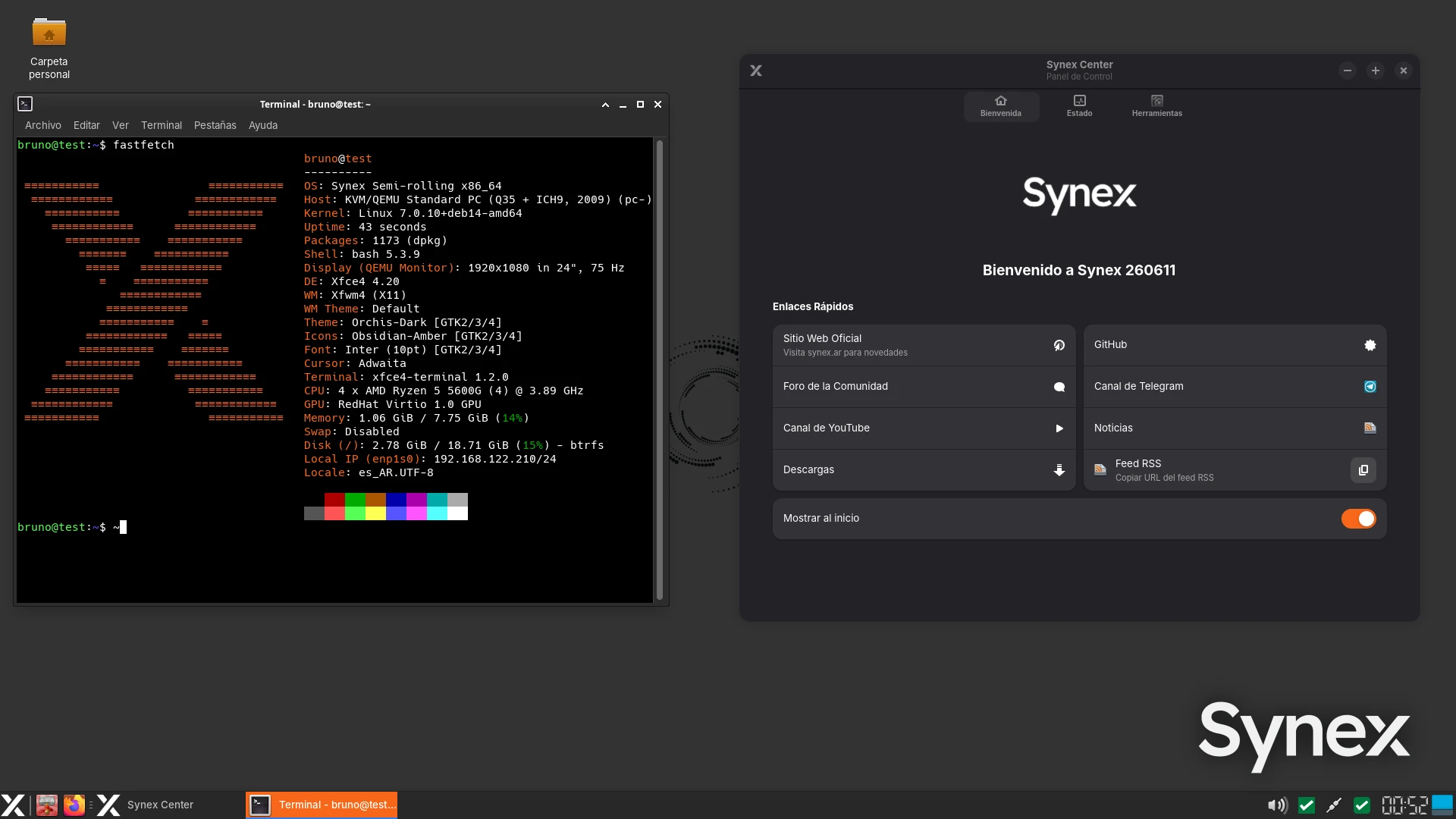
We are pleased to announce new Synex semi-rolling images, available in KDE Plasma, GNOME, and XFCE editions. This update continues the work on the Debian testing-based branch, offering newer versions of the kernel, desktop environments, and main system components while keeping coherence with the rest of the Synex ecosystem.
Synex Package Manager 1.1.1
Since the last semi-rolling image (which included Synex Package Manager 0.6.0), the application advanced several versions and incorporated significant functionality. This image arrives with SPM 1.1.1, consolidating improvements in package management, interface performance, and configuration portability between systems.
Held package management
SPM incorporates complete held package management. From a dedicated window in the packages page, the user can mark installed packages as held through apt-mark hold and release them with apt-mark unhold, with a summary of pending changes before applying modifications.
Held packages are excluded from the normal update count and presented in a secondary counter both on the updates page and in the tray indicator, preventing them from being counted as regular pending updates. The held state is clearly shown in search results and in the details of each package.
Virtualized results table
The APT and Flatpak packages pages were redesigned with a virtualized table based on Gtk.ColumnView, replacing the previous card-based listing. This change avoids the creation of thousands of widgets for broad searches, significantly improving memory usage and responsiveness when displaying large result sets.
The new table presents compact columns (name, summary, version, and status) and moves long descriptions to an external details panel shown when selecting a row. The main pages also adopted a responsive layout: fixed widths were removed and they now expand with the application window when resized or maximized.
Importable and exportable software lists
A notable addition is the ability to export the system software list (manually installed APT packages and installed Flatpak applications) and import it on another Synex system to replicate the software selection. The format is a validated JSON with format versioning and basic source system metadata.
The import includes a precheck with a confirmation summary before applying changes, reports packages or applications that are not available in the current repositories (keeping them as warnings and continuing with the rest), and installs only missing packages without modifying already installed ones. The import flow also automatically enables or repairs Flatpak support when needed, configuring the Flathub and Flathub Verified remotes both system-wide and for the user.
Purge and autoremove in APT removals
The packages page incorporates optional purge and autoremove handling in APT removals, including combined support for both operations. Transaction simulation was updated to reflect the real execution plan when these options are active, and transaction summaries clearly show the purge and autoremove choices before applying changes.
Renewed system identity
This image extends to the semi-rolling branch the system identity renewal through dpkg-divert, already present in Synex 13 stable starting with the u9 update. The identity package (synex-testing-release 1.1.0) takes over files traditionally provided by Debian to present Synex's identity consistently.
Files managed through divert include /usr/lib/os-release (with ID=synex and ID_LIKE=debian to preserve compatibility with scripts and third-party repositories), /etc/issue, /etc/issue.net, and the MOTD template. The mechanism is completely reversible: when Debian updates its base files, the Synex versions remain in place, and when uninstalling the package, the original files automatically return.
Updated components
The new images share an updated base on Debian testing / Forky. Main components include Linux kernel 7.0.10, systemd 260.1, OpenSSL 3.6.2, Mesa 26.0.8, PipeWire 1.6.6, WirePlumber 0.5.14, Firefox ESR 140.11.0, and Flatpak 1.16.6. The installer remains based on Calamares with calamares-settings-synex 1.0.26.
The KDE Plasma edition includes Plasma Desktop 6.6.5, KWin 6.6.5, and KDE Applications 26.04.0 such as Dolphin, Konsole, Ark, Kate, and Gwenview. The GNOME edition incorporates GNOME Shell 49.5, GDM3 49.2, Nautilus 50.1, and GNOME Control Center 50.1. The XFCE edition remains on the XFCE 4.20 series, with xfce4-panel 4.20.7, xfce4-session 4.20.4, xfwm4 4.20.0, and Thunar 4.20.8.
Considerations
The semi-rolling branch is intended for users who want newer versions of the desktop environment, kernel, and system components. Since it is based on Debian testing, it may receive more frequent changes than the stable edition and may occasionally require adjustments between updates. For environments where long-term stability is the priority, the Synex stable branch remains the recommended option.
Availability
The new Synex testing images for KDE Plasma, GNOME, and XFCE are available for download from SourceForge. As always, we recommend verifying the checksums of downloaded images before creating the installation media.
Download Synex Semi-rolling here.