

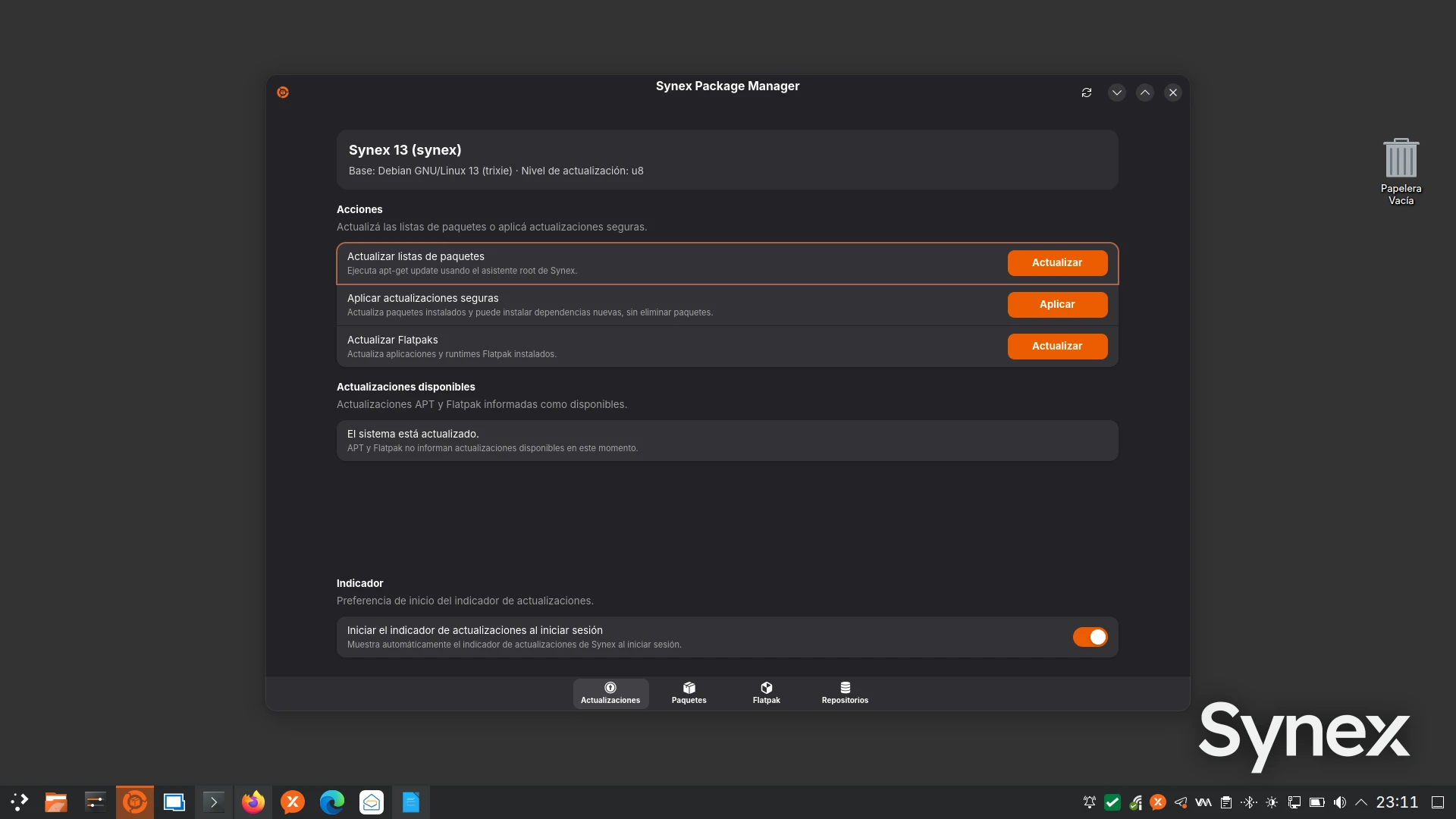
The goal of this change is to provide a more consistent experience across all Synex editions. Until now, depending on the desktop environment, users could find different tools for managing applications, updates or repositories, such as Discover, GNOME Software, MX Package Installer or external update indicators. With Synex Package Manager, we aim to simplify that workflow and bring the main software management tasks into our own application, aligned with the philosophy of the project.
Synex Package Manager already allows users to manage APT updates, search and install deb packages, manage repositories, work with Flatpak applications and use a tray-based update indicator. This makes it possible to offer a common experience across KDE, GNOME, XFCE, MATE and LXDE, without depending on different solutions for each desktop environment.
This transition is already applied in the semi-rolling Synex images, and it will be incorporated into Synex 13 stable starting with the u9 update.
This change is not intended to remove flexibility, but to organize the default experience. Advanced users will still be able to use the usual terminal tools, while Synex will provide a clearer, more integrated and more consistent graphical path for the most common software management tasks.
With this step, Synex Package Manager becomes a central part of the Synex Desktop ecosystem and of the project’s broader goal: maintaining a solid base, a simple experience and a system that is easy to extend without adding unnecessary complexity.