

We are pleased to announce the availability of Synex Server 13, the final and stable version of our server and enterprise-focused distribution. This release consolidates months of development, community feedback, and architectural refinements that make it a robust and reliable platform for critical infrastructures.
Synex Control: the heart of administration
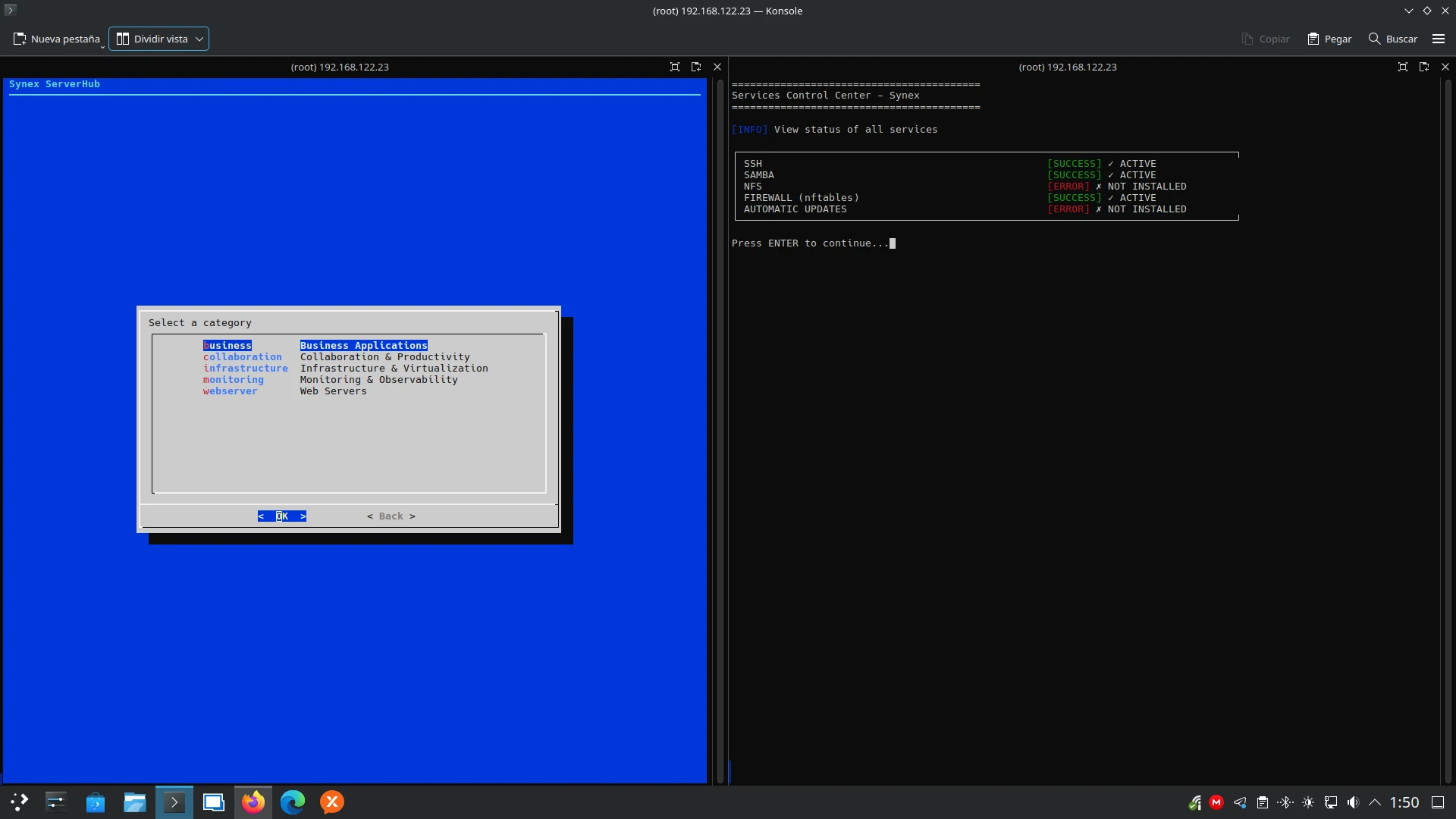
Synex Control establishes itself as the central tool for server management. Fully bilingual (Spanish/English) and with modular architecture, it offers comprehensive user and group administration, essential service configuration (SSH, NFS, Samba, Firewall, Unattended Upgrades), and a completely refactored network module.
Predictable, dependency-free network management
The network module represents one of this version's greatest achievements. Designed from scratch to provide simple, predictable behavior over "classic" Debian (ifupdown), it eliminates the need for external dependencies like resolvconf through a centralized DNS management architecture.
The system maintains persistent state in /etc/synex-control/dns.conf, separating user "intent" from applied configuration. It implements clear policies based on network context:
- DHCP without manual DNS: automatically configures gateway as resolver
- DHCP with manual DNS: respects only user-specified servers
- Static IP without DNS: pure Debian behavior (doesn't invent resolvers)
- Static IP with DNS: uses only user-specified servers
Persistence is guaranteed through custom hooks (synex-control-dns and dhcpcd.exit-hook) that automatically reapply policies when bringing up interfaces or renewing DHCP leases. The design allows complete reversibility: removing hooks returns standard Debian behavior without residue.
ServerHub: automated enterprise deployment
ServerHub continues as the modular framework for enterprise application deployment, now with complete CLI interface complementing its TUI. Available with 7 production-ready modules (LAMP, Docker, Nginx Proxy Manager, Zabbix, Nextcloud, GLPI, Odoo), it enables full automation through scripts, CI/CD integration, and remote administration without manual intervention.
synex-lvm-manager: storage administration without complexity
Storage management is simplified through synex-lvm-manager, an interactive command-line tool designed specifically for Synex/Debian. It reduces the complexity of working with LVM and LUKS2 encryption without sacrificing technical control: allows creating and managing physical volumes, volume groups, and logical volumes in an assisted manner, preparing disks with LUKS2 encryption and integrating them into LVM, reviewing states and available space before applying changes, and automatically updating system configuration.
Optimized base and specialized tools
Synex Server 13 is built on Debian 13 (Trixie) with a carefully selected base system including essential tools organized by function: network management (bind9-dnsutils, netcat, traceroute, iftop), system monitoring (htop, duf), transfer and synchronization (rsync, curl, wget, git), terminal multiplexing (screen), advanced filesystem support (btrfs-progs, xfsprogs, ntfs-3g), time synchronization (chrony), and preconfigured remote administration (openssh-server). The installation includes complete UEFI/Legacy support with GRUB and optional Secure Boot.
Looking forward
We will continue refining tools, adding ServerHub modules, and responding to real needs of system administrators. Our commitment remains: professional simplicity without sacrificing power.
As always, we invite you to test, report experiences, and contribute suggestions on our forum.
You can download Synex Server 13 from here.